Concrete Repairs in Christchurch: What’s Wrong and What It Costs to Fix
Most concrete problems fall into one of two categories: the surface has worn out, or the ground underneath has moved. The first is usually repairable for a fraction of replacement cost. The second is not, and no amount of patching will hold it.
Working out which one you have is the whole job. Repairing sound concrete costs roughly $70–$180 per square metre to resurface, against $130–$260/m² to break out and re-pour — so getting the diagnosis right is worth real money either way. Patch a slab that is still moving and you will be looking at the same crack next winter.
This guide walks through the symptoms we see most often on Christchurch driveways, paths, patios, steps and garage floors, what each one is actually telling you, and what it takes to fix properly.
Diagnose It From the Symptom
Find what you are looking at in the left column. The cause column is the honest answer, which is not always the one people expect.
| What you see | Usual cause | What it needs |
|---|---|---|
| Fine cracks in a neat pattern, appeared early | Plastic shrinkage — the surface dried too fast, often a nor’west wind on pour day | Cosmetic. Seal and monitor. Rarely structural. |
| Straight crack running along a joint line | Working as designed — the joint did its job | Nothing, beyond keeping it sealed against water |
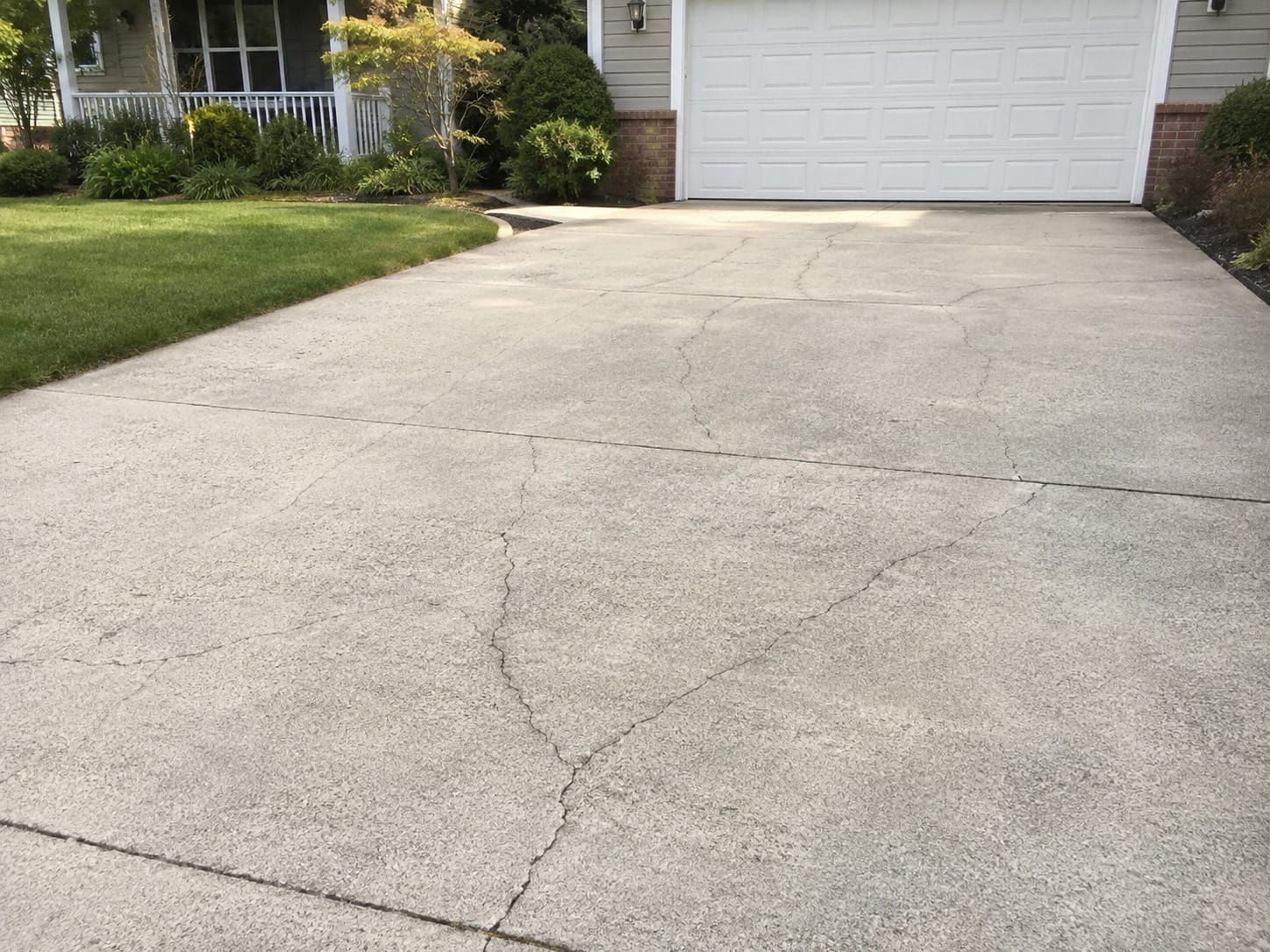
| Random crack under about 6 mm wide, slab still level | Shrinkage, thin slab, or joints spaced too far apart | Crack fill and seal. Cost-effective and lasts. |
| Crack wider than about 6 mm, or edges at different heights | Ground movement or base failure underneath | Investigate the base. Usually points to replacement, not repair. |
| Whole section has dropped or tilted | Basecourse was under-compacted, or fill has settled | Slab lifting and levelling, or break out and re-lay |
| Surface flaking, pitting or lifting in sheets | Spalling — surface layer damaged by water and freeze-thaw, or a weak finish | Grind and resurface if the slab beneath is sound |
| Water sitting in puddles after rain | Insufficient fall, or the slab has settled into a dish | Re-level, or add drainage and channels |
| Rust stains with cracks along a line | Reinforcement corroding and expanding — mesh sat too close to the surface | Structural. Needs assessment, generally replacement of that section |
| Faded, patchy or discoloured but sound | UV, efflorescence, wear on the surface paste | Clean, then reseal or a decorative overlay |
Widths are a guide, not a rule. Two cracks the same width can mean different things depending on whether they are still moving — which is what a proper look on site establishes.
The Christchurch Question: Is It the Earthquakes?
It is the first thing people ask, and the honest answer is usually no.
The 2010–2011 earthquakes did enormous damage to Canterbury concrete, and there is genuine, documented land damage across the city. But the majority of residential concrete cracking we are called out to in Christchurch today is not seismic. It is basecourse preparation that was too thin or too poorly compacted, slabs poured at 75–80 mm instead of 100 mm, control joints spaced too far apart, or steel mesh that ended up sitting on the hardfill instead of within the slab.
Those are workmanship and specification problems, and they produce cracking on a five to fifteen year timeframe regardless of seismic activity. Attributing everything to the earthquakes is convenient, but it means the actual cause never gets fixed — and if you re-pour onto the same unimproved base, you get the same result.
Where the earthquakes are genuinely relevant is the ground. The MBIE technical categories — TC1, TC2 and TC3 — classify land by liquefaction vulnerability and exist to guide house foundation design, not driveways. They are land classifications, not concrete grades, and nobody can tell you your category from a photo of a crack. But if your property is on land that required enhanced or engineered foundations for the house, the same variable silts and high water table are under your slab, and that raises the bar on base preparation considerably.
For land damage and foundation-level problems rather than surface concrete, see liquefaction assessment and repair and foundation repair.
The Repair Options, and When Each One Is Right
These run from cheapest to most involved. The right answer is the least invasive option that actually addresses the cause.
Crack filling and sealing
For stable cracks under about 6 mm on a level slab. The crack is cut out, cleaned and filled with a flexible sealant that moves with the concrete rather than cracking alongside it. Cheap, quick, and genuinely durable when the slab is not moving. Rigid filler in a moving crack fails within a season.
Grinding
Removes a raised edge, a trip hazard where two slabs have shifted, or a damaged surface layer. Often the fix for a path or step that has become dangerous rather than ugly. Also the preparation step before most overlays. See concrete grinding.
Slab lifting and levelling
Where a section has sunk but the concrete itself is intact, grout or foam injected underneath lifts it back to level. Far cheaper and faster than replacement, and it fills the void that caused the settlement. Not an option if the slab is badly broken. See concrete lifting and levelling.
Resurfacing and overlays
A new wearing surface over a sound slab — a thin polymer-modified coat at 2–4 mm for a smooth recoat, or a 10–20 mm topping that can be stamped or stencilled. Roughly $70–$180/m² and adds 8–15 years. The condition is a structurally sound, non-moving slab. See concrete resurfacing.
Section replacement
Cutting out and re-pouring the failed area rather than the whole slab. Works where damage is localised and the rest is genuinely sound. The join will always be visible, which is worth knowing before you choose it on a front driveway.
Full replacement
Break out, remove the spoil, re-prepare and properly compact the base, re-pour to the correct thickness with mesh positioned right. Around $130–$260/m², and the only real answer where the base has failed. Buys 25 years or more. See concrete replacement.
Repair, Resurface or Replace — the Numbers
| Option | Cost guide | Adds | Requires |
|---|---|---|---|
| Crack fill and seal | Lowest cost, often a half-day job | Several years, stops water ingress | Stable cracks, level slab |
| Slab lifting and levelling | Well below replacement | Years — restores level and fills the void | Concrete intact, not badly broken |
| Resurfacing / overlay | $70–$180/m² | 8–15 years | Structurally sound slab, no active movement |
| Section replacement | Between the two, per m² | 25 years+ on that section | Localised damage, sound surrounds |
| Full replacement | $130–$260/m² | 25–35 years | Base failure, widespread cracking, drainage problems |
Resurfacing is roughly half the cost of removing and re-pouring, which is why it is worth establishing whether the slab is genuinely sound before defaulting to replacement.
The One Test That Decides It
Everything above hinges on a single question: is the slab still moving?
A sound slab with a tired surface is a resurfacing job, and you save roughly half the cost of replacement. A slab sitting on a base that has failed is a replacement job, and every dollar spent on the surface is wasted — active movement telegraphs through a new overlay, usually within a season and always eventually.
The signals that the base has gone are consistent: cracks wider than about 6 mm, edges at different heights either side of a crack, whole sections that have dropped or tilted, water pooling where it used to run off, and cracks that have visibly grown since you first noticed them. Rust staining along a crack line is its own warning — corroding reinforcement expands and will keep splitting the concrete from inside.
A rough field check anyone can do: mark each end of a crack with a pencil line and note the date. If the crack has extended past your marks a few months later, it is live. That is not a substitute for someone looking at the base properly, but it tells you which conversation you are having.
What Causes Concrete to Fail Early in Canterbury
Five causes account for most of the early failures we see, and all of them are avoidable.
Base preparation. The most common by a wide margin. Not enough hardfill, or hardfill that was tipped in and levelled rather than compacted in layers. It looks identical on day one and diverges completely by year five.
Slab thickness. A driveway poured at 75 or 80 mm to save on concrete will crack under a vehicle. Residential driveways want 100 mm, and 125–150 mm if a boat, campervan or work truck parks on them.
Reinforcement position. Steel mesh has to sit within the slab depth on chairs to do anything. Mesh lying on the base is a common shortcut and contributes nothing to crack control — and mesh too near the surface will eventually rust and split the slab.
Joint spacing. Concrete shrinks and will crack. Control joints exist to decide where. Joints too far apart, or missing entirely, and the slab picks its own line.
Curing conditions. Christchurch specific, this one. A hot dry nor’wester can lift the temperature ten degrees in minutes and strips moisture off a fresh surface faster than it can rise from below, causing plastic shrinkage cracking within hours. Winter frost at the other extreme — overnight lows of 0°C to −2°C — weakens a surface that freezes before it has cured. Neither is a reason not to pour, but both need managing on the day.
Concrete We Repair Beyond Driveways
Driveways are the bulk of it, but the same diagnosis applies to most concrete around a property.
Paths and footpaths
Lifted edges and trip hazards are the usual issue, often from tree roots or settlement. Grinding fixes the hazard cheaply; a dropped section needs lifting or relaying. See patios and pathways.
Patios and outdoor areas
Usually a surface problem rather than a structural one — staining, wear, or an outdated finish. Good candidates for a decorative overlay, which changes the look for a fraction of replacement cost.
Steps and thresholds
Chipped nosings and spalled edges are both a safety issue and a water entry point. Repaired with a bonded mortar and reprofiled, or recast where the damage runs deep.
Garage and shed floors
Oil-stained, dusting or pitted floors. Grinding and sealing or a floor coating usually resolves it. Cracks in a garage floor need checking against the foundation rather than treated as surface damage.
Kerbing and edging
Damaged kerb sections and edge restraints, which matter more than they look — a failed edge lets the base migrate out and undermines the slab beside it. See concrete kerbing.
Potholes and localised breakouts
Cut back to sound material, re-prepare the base under the hole, and patch. Patching over a soft base simply relocates the problem. See pothole and crack patching.
Frequently Asked Questions
How much do concrete repairs cost in Christchurch?
It depends entirely on which repair you need. Crack filling and sealing is a low-cost, often half-day job. Resurfacing a sound slab runs roughly $70–$180 per square metre and adds 8–15 years. Breaking out and re-pouring is $130–$260 per square metre and gives you 25 years or more. Slab lifting and levelling sits well below replacement cost where the concrete itself is still intact. The single biggest factor in the price is whether the base underneath needs fixing.
Should I repair or replace my cracked concrete?
The deciding question is whether the slab is still moving. If it is structurally sound and only the surface has deteriorated, repair or resurfacing costs about half of replacement and is the sensible choice. If cracks are wider than roughly 6 mm, edges sit at different heights, sections have dropped, or water now pools where it used to drain, the base has likely failed and replacement is the only lasting fix. Resurfacing a moving slab will crack again, usually within a season.
Is the cracking in my concrete earthquake damage?
Usually not. Most residential concrete cracking in Christchurch today comes down to base preparation, slab thickness, joint spacing, or reinforcement position rather than seismic movement. The earthquakes did cause real land damage across Canterbury, and variable ground remains a genuine factor in how well a slab performs — but a crack on its own is not evidence of earthquake damage, and treating it as such tends to mean the real cause goes unaddressed. Land damage and foundation issues are a separate assessment from surface concrete repair.
Can you repair a concrete driveway without replacing all of it?
Often, yes. Options include filling and sealing individual cracks, grinding down a raised edge, injecting under a sunken section to lift it back to level, resurfacing the whole area with an overlay, or cutting out and re-pouring just the failed section. All of them depend on the surrounding slab being sound. Where only part of a driveway has failed and the rest is genuinely solid, section replacement is usually the most economical route — though the join will always be visible.
How long do concrete repairs last?
A sealed crack on a stable slab holds for several years and can be redone easily. A resurfacing or overlay adds 8–15 years when the slab underneath is sound and properly prepared. Slab lifting lasts as long as the void stays filled and the ground stays stable. Full replacement, done with the right basecourse depth, compaction, thickness and reinforcement, should give you 25–35 years. In every case the lifespan is set by the ground underneath rather than the repair material.
Do you do concrete repairs outside Christchurch city?
Yes — across Canterbury, including Rolleston, Lincoln, Prebbleton and West Melton in the Selwyn district, and Rangiora and Kaiapoi in Waimakariri, plus Halswell, Wigram, Belfast, Marshland and the wider Christchurch suburbs. Ground conditions vary noticeably between these areas, which is part of why we look at the base on site rather than quoting from a description.
What is spalling and can it be fixed?
Spalling is when the surface layer of concrete flakes, pits or lifts away in sheets, exposing the aggregate underneath. It is usually caused by water getting into the surface and freeze-thaw cycling, a weak or over-worked finish, or de-icing salts. If the slab beneath is sound it is very fixable — grind back to solid concrete and resurface. If spalling is accompanied by rust staining, the reinforcement is corroding and that is a structural problem rather than a surface one.
Get Your Concrete Assessed in Christchurch
Send us a photo or have us take a look on site. Christchurch Concrete Driveways will tell you straight whether your concrete needs a $200 crack seal or a full re-pour — and we will explain what caused it, so the same thing does not happen to the next slab. Call 03 660 1155 for a free assessment.