
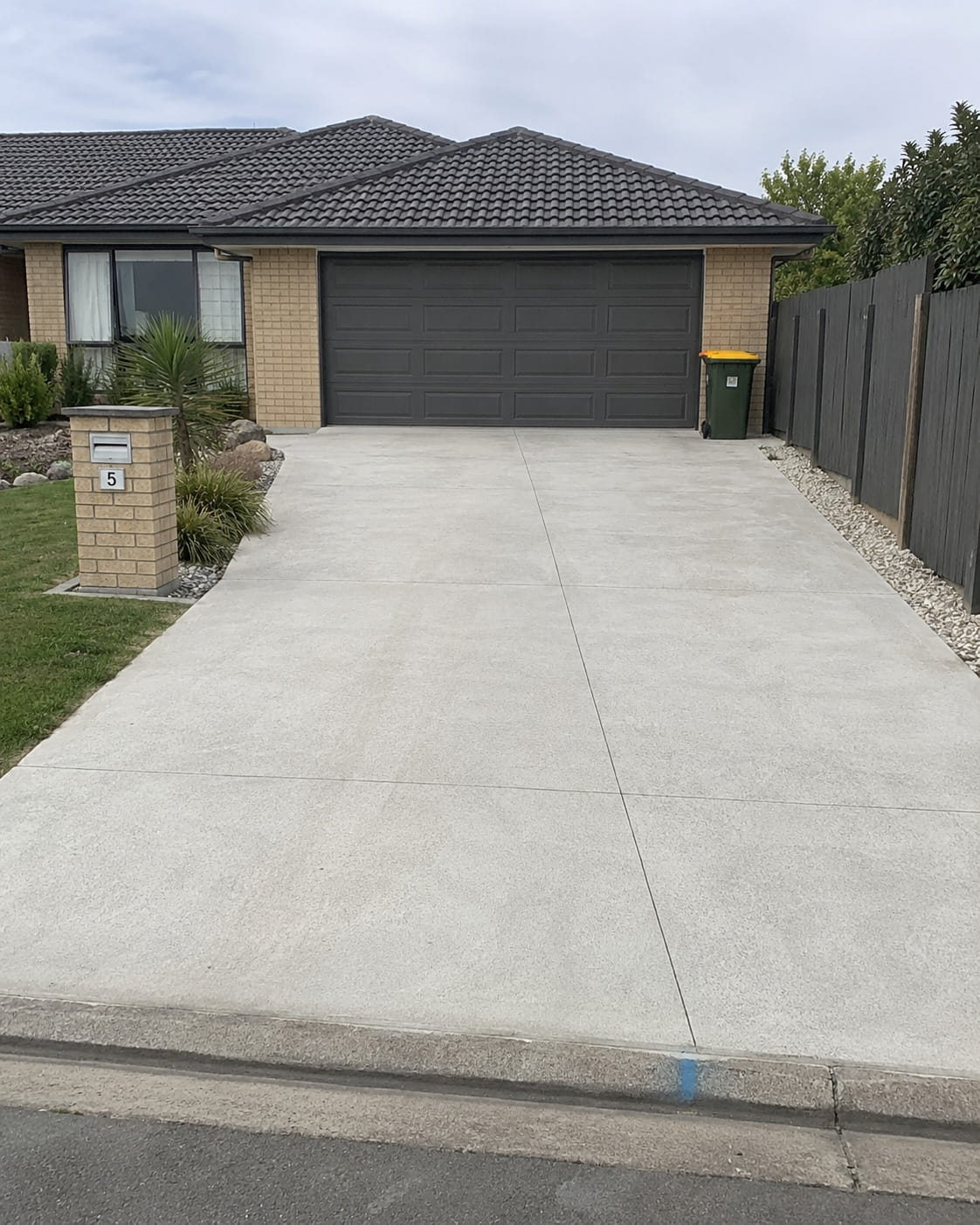
Concrete Kerbing Christchurch
Garden beds that spill onto the driveway, mulch washing across the path after heavy rain, a lawn edge that has crept out of shape over three or four summers — small problems, but they make an otherwise tidy property look unfinished. Timber edging is the usual fix, and it usually rots or lifts within a few years.
A poured edge solves it permanently. Machine-extruded and hand-formed concrete kerbing in Christchurch gives you a crisp, continuous line that holds soil and mulch where it belongs, stops grass creeping into the garden, and lets the mower run clean along the edge without scalping it. We shape it around curves as easily as straight runs, match the colour and finish to your existing driveway, and set the levels so water still drains where it should. Once it has cured, it asks nothing of you beyond the occasional wash.
Concrete Edging Christchurch
Edging and kerbing describe much the same thing at different scales. A low garden edge — flush with the lawn or standing 50 to 75mm proud — is about definition and keeping materials in place. A taller kerb does structural work: retaining a raised bed, protecting a lawn from vehicles, or channelling water toward a sump.
We form both. The profile is worth thinking about before we start, because it decides how the edge behaves in use. A rounded bullnose is forgiving on mower wheels and bare feet. A square profile reads sharper and suits contemporary landscaping. A mower strip — a wider, flat band set level with the turf — lets you mow straight over the top and never trim an edge again.
Where Kerbing Earns Its Keep
The most common request is a border between lawn and garden, where the payoff is mostly time saved: no more edging by hand every second weekend. Close behind is driveway edging, which stops the seal or aggregate spreading sideways and protects the slab edge from crumbling under tyre loads.
It also solves problems that are less obvious until you live with them. A kerb along a shingle drive keeps stones out of the lawn. A raised edge around a vegetable garden stops soil washing onto paths in a Canterbury nor’wester. And on sloping sections, a well-placed kerb can direct stormwater away from the house instead of letting it sheet across a path.
Concrete Kerbing Contractors in Christchurch
Continuous kerbing goes down faster than most people expect. On a typical residential job we mark out the run with you, cut and prepare the ground, then extrude the kerb in one continuous pass so there are no butt joints to crack open later. Control joints are cut at set intervals so the edge can move without splitting.
Our contractors are fully insured and work tidily — we protect the lawn we are working over, barrow away spoil, and leave the site swept. Most gardens are finished within a day, and because the kerb cures in place there is no waiting on a delivery of precast units that may not match.
Colours, Finishes and Matching Existing Concrete
Kerbing does not have to read as grey. Oxide can be added through the mix in charcoal, terracotta, sand or a soft black, and the surface can be left smooth, brushed lightly for texture, or stamped with a subtle pattern along the top face.
If you already have a coloured or exposed aggregate drive, bring us in and we will work to it. We can also pair kerbing with decorative concrete elsewhere on the property, or lay it alongside new paths and patios so the whole scheme is poured to one standard by one team.
Christchurch Concrete Kerbing Questions
How much does concrete kerbing cost per metre in Christchurch?
Most residential kerbing is priced by the lineal metre, and the rate moves with profile, colour and how easily we can get a machine to the run. Tight access, tree roots or heavy soil removal will lift it. Call 03 660 1155 with a rough length and we will give you a realistic figure, then confirm it on site.
Will the kerb crack over time?
Properly installed kerbing has control joints cut at regular spacing, which gives the concrete somewhere to move as it expands and contracts. That is what prevents random cracking. Ground movement under a poorly compacted base is the usual culprit when kerbing does fail, which is why we spend time on preparation.
Can you lay kerbing on a curve?
Yes, and curves are where continuous poured kerbing really outperforms precast blocks. Because we extrude it in place, we can follow a sweeping garden bed or a circular planter with a smooth, unbroken line rather than a series of short straight segments.
How soon can I mow or plant against it?
Keep off it for the first 24 hours, then treat it gently for about a week while it gains strength. After that you can mow over a strip or backfill and plant right up against the edge as normal.