Concrete Driveway Installation: What Actually Happens, Day by Day
A standard residential concrete driveway installation in Christchurch takes five to ten working days from first dig to being able to drive on it. The concrete itself is on site for about four hours of that. Almost everything that determines whether the driveway is still flat and uncracked in twenty years happens before the truck arrives.
That is the useful thing to understand as a homeowner. Once concrete is poured, you cannot inspect the basecourse, check the mesh position, or verify the slab depth. Those are one-time opportunities, and they happen on specific days.
Here is what each stage involves, how long it takes, and what is worth looking at while you still can.
The Timeline at a Glance
A typical 50–80 m² residential driveway on a site with reasonable truck access. Bigger jobs, poor access, or drainage work extend the middle stages rather than the pour.
| Stage | Typical duration | What you can check |
|---|---|---|
| Site visit and quote | Under an hour | That they looked at the ground, access and drainage — not just measured the area |
| Council vehicle crossing approval | Allow 2–4 weeks before work starts | Which council, and that the application is actually in |
| Excavation and spoil removal | 1 day | Depth of the dig, and that soft or organic material is coming out |
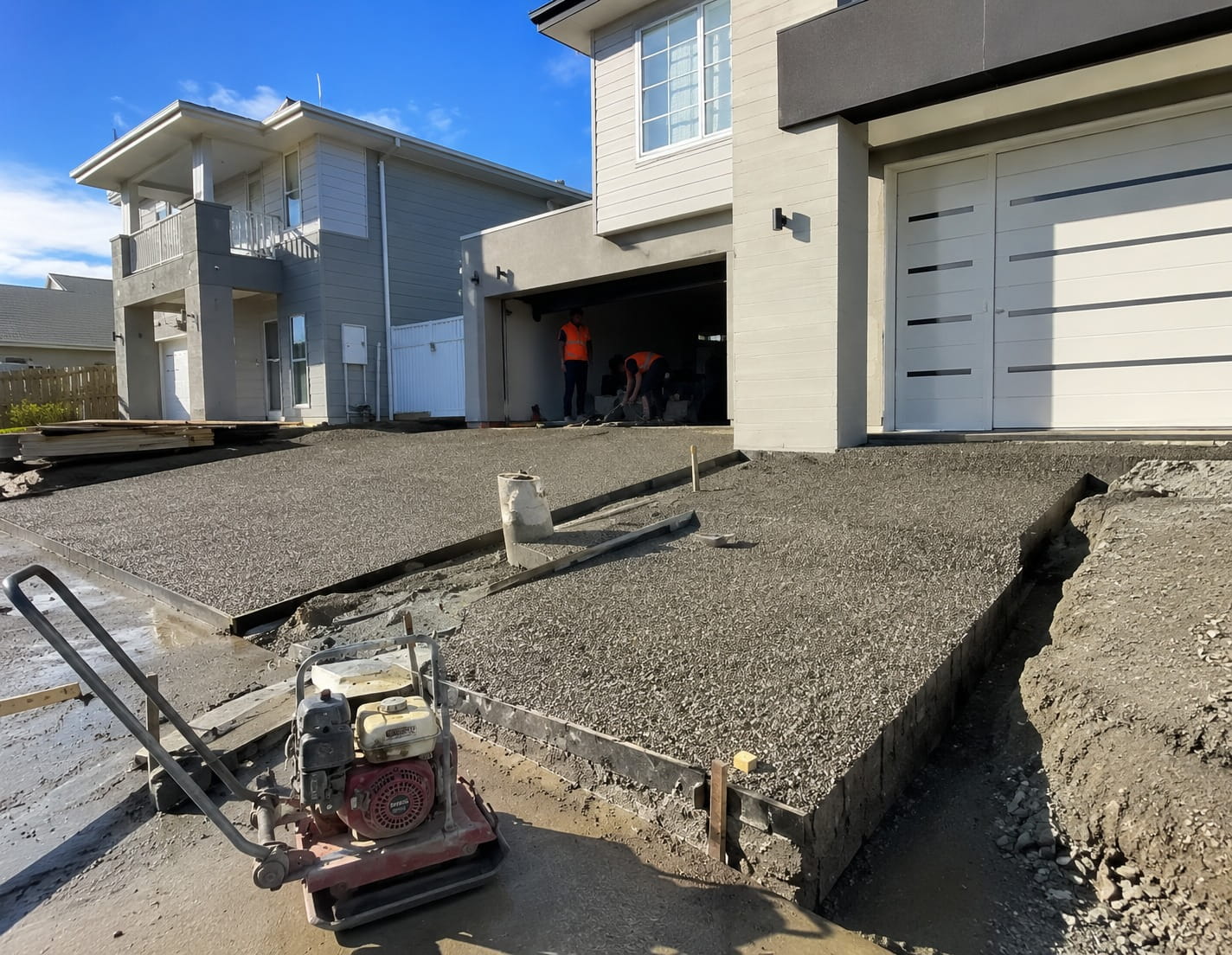
| Basecourse laid and compacted | 1–2 days | Hardfill depth, and that it is compacted in layers rather than tipped and levelled |
| Boxing, mesh and joint set-out | 1 day | Mesh sitting on chairs, not on the base. Levels and falls set for drainage. |
| The pour and finish | Half a day, around 4 hours | Slab depth as you go, and the finish being worked at the right time |
| Curing before foot traffic | 24–48 hours | Curing protection actually in place, especially in wind or frost |
| Curing before vehicles | 7 days minimum | Barriers still up. This one gets rushed and it costs people driveways. |
Full design strength takes around 28 days. You can drive a car on it well before then, but keep heavy vehicles and skip bins off it for the first month.
Before Anything Starts: Council Approval
If your driveway meets the road, the crossing point sits on council land and needs written approval before work begins. This is the stage that most often delays a project, because people discover it after booking a crew.
Which council depends on where you are. Christchurch City Council covers the city and suburbs, and requires a vehicle crossing permit with work meeting the Construction Standard Specifications Part 6. The Traffic and Parking Bylaw 2017 makes it an offence to construct or alter a crossing over a footpath or road without prior written permission from an authorised officer.
Selwyn District Council covers Rolleston, Lincoln, Prebbleton and West Melton, and needs an Application to Form a Vehicle Crossing. Selwyn has a quirk worth knowing: it uses two kerb profiles, and the low profile kerb common through Rolleston township needs no kerb cutdown for a single-house driveway, while a standard kerb does. A shared right of way always needs a cutdown, and three or more houses needs a heavy-duty reinforcement beam as well.
Waimakariri District Council covers Rangiora and Kaiapoi under the Vehicle Crossing Bylaw 2019, and has the most important sequencing catch of the three — the vehicle crossing location inspection has to be approved before your building consent is granted. On a new build, that has to happen early.
In all three districts the cost falls on the property owner, and a crossing that does not meet specification gets upgraded at the owner’s expense. Our guide to Christchurch council requirements covers widths, gradients and permit costs in detail.
Stage by Stage
1. Excavation
The old surface, topsoil and any soft or organic material comes out — deep enough to fit the basecourse plus the slab and still finish at the right level against your garage, path and the road. Spoil is loaded and carted off. On sites where a truck cannot get close, this is where costs climb, because material moves by barrow or mini-digger instead.
2. Basecourse
Crushed hardfill laid and compacted in layers, each one rolled before the next goes on. Depth depends on your ground and the load the driveway will carry. This is the single biggest predictor of a driveway’s life, and the easiest stage for a cheap quote to shave — a tipped and levelled base looks identical on day one and fails by year five.
3. Boxing and levels
Timber or steel formwork sets the edges, the finished height and the falls. A crossfall of around 1–2% minimum makes water run off instead of pooling. Where the drive falls towards a garage, a channel or sump goes in now — retrofitting drainage into a finished slab is expensive and never as neat.
4. Reinforcement
Welded steel mesh to AS/NZS 4671, sitting on chairs so it ends up within the slab depth. Mesh lying on the hardfill does essentially nothing for crack control, and mesh too close to the surface will rust and split the slab years later. This is the easiest thing for a homeowner to check and the most commonly cut corner.
5. The pour
Concrete is placed, spread, screeded to level and compacted to remove air voids. Residential driveways are normally 100 mm thick at 20–25 MPa, or 125–150 mm where a boat, campervan or work truck will park. A truck typically carries around 6 m³, so a mid-sized driveway is two or three loads arriving in sequence.
6. Finishing
Timing is everything here. Float too early and you bring water to the surface and weaken it; too late and you cannot work it. A broom finish gives grip. Exposed aggregate needs a surface retarder and a wash-off at the right moment. Control joints are cut or tooled at planned spacings to decide where the slab cracks.
7. Curing
Concrete gains strength through a chemical reaction that needs moisture — it does not simply dry. Curing compound, covers, or damp curing keeps water in the slab. Skimp here and you get a weak, dusty surface that spalls in a few years, no matter how good the mix was.
8. Handover
Boxing stripped, joints sealed, edges tidied, site cleared. Barriers stay up. Foot traffic after 24–48 hours, cars after seven days, heavy vehicles after 28. Sealing, if you want it, comes later once the slab has fully cured.
The Christchurch Weather Factor
Two Canterbury conditions genuinely affect an installation, and a local crew should be planning around both.
The nor’wester is the significant one. This hot, dry wind coming over the Southern Alps can lift temperatures around ten degrees in minutes and works across a fresh slab like a giant hairdryer. High wind and low humidity pull water off the surface faster than it can rise from within, which causes plastic shrinkage cracking — fine cracks that show up within hours of the pour. The response is windbreaks, evaporative retarders, an earlier start, or postponing the pour. A crew that ignores a nor’west forecast is gambling with your driveway.
At the other end, frost. Overnight lows of 0°C to −2°C are ordinary in a Christchurch winter, and concrete that freezes before it has cured ends up with a weakened surface. Winter pours work fine with an adjusted mix and proper protection, but they need active management.
Spring and autumn are the easiest windows here. Work happens year-round, and it should — but the crew has to adjust the timing, the mix and the curing rather than pour to the same recipe in February and July.
What Slows an Installation Down
Council approval. Comfortably the most common delay, and entirely avoidable by applying early.
Access. A concrete truck needs to get close enough for the chute, or you are into pumping or barrowing. Narrow sections, tight corners, overhead wires and soft ground all add time and cost.
Ground surprises. Old foundations, buried services, unrecorded fill, or a water table higher than expected. These turn up during excavation and can change the base specification.
Weather. Not just rain on pour day — the days either side matter for curing.
Drainage. If the driveway needs stormwater work, that is a separate stage. Christchurch City Council permits up to 65% of a site as impervious surface, and on a small section a large driveway can push you against that limit, which changes the design.
What to Ask Before You Sign
These are the answers that tell you whether you are comparing two like quotes or a proper job against a cheap one.
| Question | What a good answer sounds like |
|---|---|
| How thick is the slab? | A specific number — 100 mm, or 125–150 mm for heavy vehicles. Written on the quote. |
| How deep is the basecourse, and how is it compacted? | A depth, plus compaction in layers. Vague answers here are the warning sign. |
| What concrete strength? | Typically 20–25 MPa for residential work, stated in the quote. |
| How is the mesh supported? | On chairs, within the slab depth. If the answer is "we lay it on the base", walk. |
| Where are the control joints? | A set-out plan or at least a spacing. Not "we will see how it goes". |
| Who applies for the vehicle crossing? | Either they do it, or they tell you clearly that you do — and which council. |
| How will it be cured? | A named method, and a plan for wind and frost. |
| When can I drive on it? | Seven days for cars, 28 for heavy vehicles. Anyone saying two days is guessing. |
Frequently Asked Questions
How long does a concrete driveway installation take in Christchurch?
Around five to ten working days on site for a typical residential driveway, from excavation to being able to drive on it. The pour itself is only about four hours. On top of that, allow two to four weeks beforehand for council vehicle crossing approval. Poor site access, drainage work, or unexpected ground conditions extend the preparation stages rather than the pour.
How long before I can drive on a new concrete driveway?
Foot traffic after 24–48 hours, and cars after seven days as a minimum. Keep heavy vehicles, trailers, skip bins and delivery trucks off it for 28 days, which is when concrete reaches its design strength. Driving on a slab too early can cause cracking that will not show up for months, and it is not covered by any workmanship guarantee.
Do I need council approval to install a concrete driveway?
You need written council approval for the vehicle crossing wherever the driveway crosses the berm and kerb onto the road, whether you are forming a new one, widening it, or reinstating an old one. Christchurch City Council covers the city, Selwyn District Council covers Rolleston, Lincoln, Prebbleton and West Melton, and Waimakariri District Council covers Rangiora and Kaiapoi. In Waimakariri the crossing inspection must be approved before a building consent is granted, so apply early on a new build.
What thickness should a new concrete driveway be?
A residential driveway carrying cars is normally 100 mm thick, poured at around 20–25 MPa over a properly compacted basecourse with steel mesh reinforcement positioned within the slab depth. If a boat, campervan, trailer or work truck will be parked on it, 125–150 mm is the right specification. The thickness should appear on your written quote — it is a real cost difference and should not be left to assumption.
Can concrete be poured in winter in Christchurch?
Yes, with the right mix and proper protection. The issue is frost — overnight lows of 0°C to −2°C are normal in a Christchurch winter, and concrete that freezes while still curing ends up with a weakened surface that can spall later. Winter installations need an adjusted mix, attention to pour timing, and insulated covers or curing blankets. Spring and autumn are easier windows, but winter work is perfectly achievable when it is managed rather than ignored.
What should I check during the installation?
Three things, all before the concrete arrives, because you cannot inspect them afterwards. First, the depth of the excavation and that soft material has been removed. Second, that the basecourse has been compacted in layers rather than tipped and levelled. Third, that the steel mesh is sitting up on chairs so it will end up inside the slab rather than underneath it. Then during the pour, watch that the slab depth is holding at the specified thickness across the whole area.
How much does concrete driveway installation cost?
Plain broom-finish concrete in Christchurch typically runs $100–$180 per square metre installed, with exposed aggregate and coloured finishes at $150–$230. For a 50–100 m² driveway that is roughly $3,750–$15,000. The variables that move the price most are site access, how much excavation and spoil removal is needed, basecourse depth, slab thickness, drainage work, and whether an existing driveway has to come out first.
Book a Driveway Installation Quote
Christchurch Concrete Driveways will walk your site, check the ground and access, sort the vehicle crossing with the right council, and give you a written quote that states slab thickness, basecourse depth and concrete strength — so you know exactly what you are buying. Call 03 660 1155 for a free estimate.